
Pontotoc Projected Versus Actual Release
A projected date is a present estimate based on sentence information held by the responsible corrections agency. For an active Oklahoma state sentence, ODOC applies its sentence-administration rules and the data in the person’s record. That figure can help plan for a possible end of custody, but it is not a promise. It also does not prove that release took place.
An actual release date records a completed custody event. At the Pontotoc County Justice Center, that event may be a direct release after bond, time served, dismissal, or a court order. It may instead be a transfer to ODOC, another county, tribal or federal custody, or treatment. The jail’s release timestamp closes or changes the county booking, yet the destination determines whether the person entered the community.
A pretrial detainee has no sentence completion date. The court may set bond or issue an order, while the jail must process it and check for other holds. Even posted bond does not supply a safe exit-time estimate. No official Pontotoc County release-hour or processing-duration rule was found.
Find a Pontotoc Projected Date
First identify the custody system. ODOC computes dates for people committed to Oklahoma state corrections. It does not supply a date for every person booked into the county jail. A short county sentence, a pretrial case, and a state prison term each require a different source.
- Collect the full name, date of birth, Pontotoc case number, booking date, and DOC number if one exists.
- Read the Pontotoc court docket to determine whether the person is awaiting trial, serving a county term, or committed to ODOC.
- For a state commitment, open OK Offender Lookup Basic Search. Use the DOC number when known, or combine the name and birth date.
- Complete the CAPTCHA and open the identity-matched detail. Preserve the exact label shown for any tentative, projected, or discharge field.
- For a county-jail term, ask the sheriff for the release timestamp, release code, and destination. Pair it with the court’s Judgment and Sentence.
- Confirm the completed event with the custodian. Do not turn a calculated date or court order date into an actual departure time.
Research verified ODOC’s search inputs but could not pass the CAPTCHA to confirm the current detail-page label on a controlled active record. Therefore, the result should be quoted exactly as it appears. Do not assume the portal always says “Projected Release Date,” and do not claim that a photo or historical release field is present without seeing it.
The official ODOC search entry shown below illustrates the CAPTCHA-protected route for a Pontotoc County state-sentence lookup.
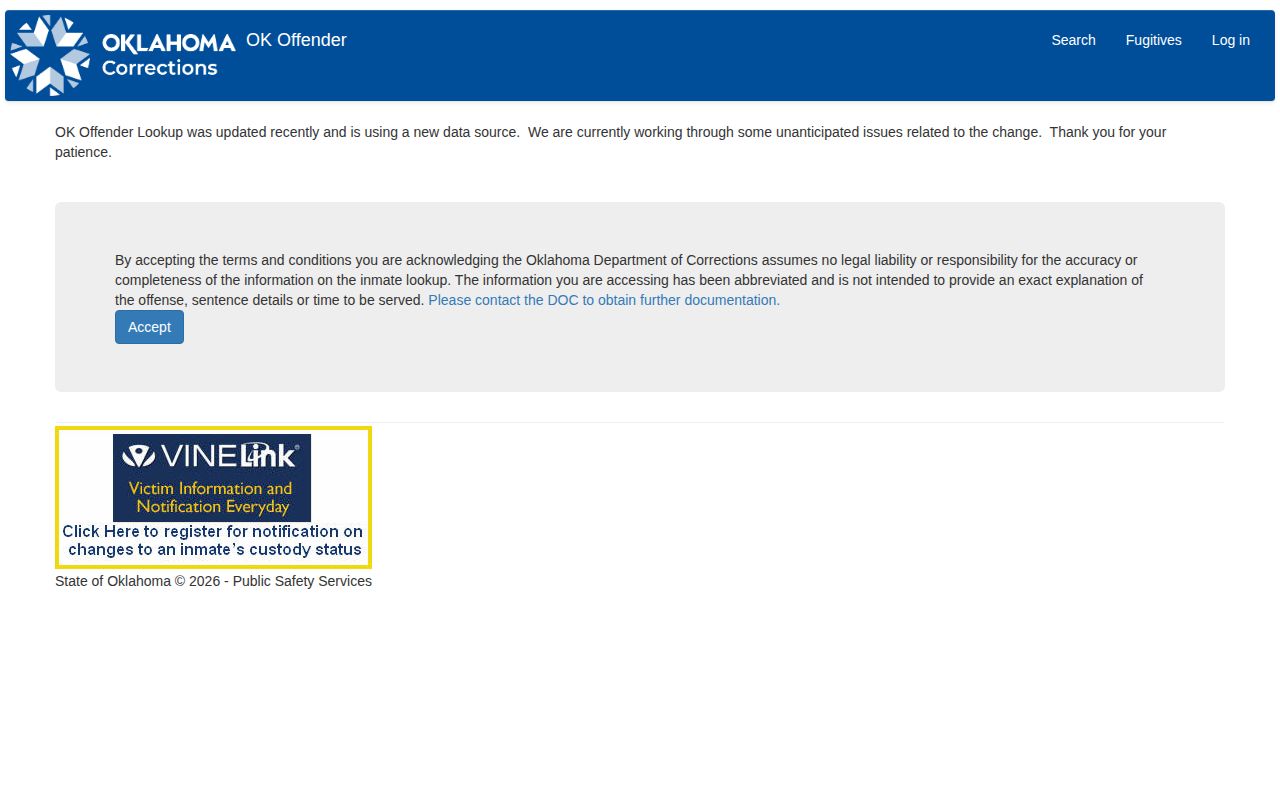
The form is a state-custody locator, so a county bond-out belongs with the sheriff and court instead.
Note: A person leaving Pontotoc’s jail for ODOC has changed custodians, not reached a community release date.
Oklahoma Earned-Credit Date Rules
ODOC Sentence Administration policy OP-060211 provides the operational framework for calculating an Oklahoma state sentence. The calculation can include the sentence start, jail-time credit, whether terms run together or one after another, earned-credit class, achievement credits, disciplinary losses or restoration, court corrections, commutation, and parole action. Each is a distinct input.
Title 57, Section 138 is Oklahoma’s earned-credit statute. Its class structure awards monthly credits by class level, with fewer or no credits at lower levels and more at higher ones. Certain achievement credits may also apply. Amendments, exclusions, and the person’s own record matter, so the statute should not be turned into a do-it-yourself calculator.
Credits can be earned, withheld, lost, or restored. Concurrent sentences run at the same time, while consecutive sentences run one after another. Jail-time credit may count time already held under the terms recognized in the case. A court correction can alter the source sentence itself. ODOC must reconcile those elements before presenting an administrative estimate.
The ODOC classification and case-management policy index links the sentence-administration policy and is shown in the official capture below.
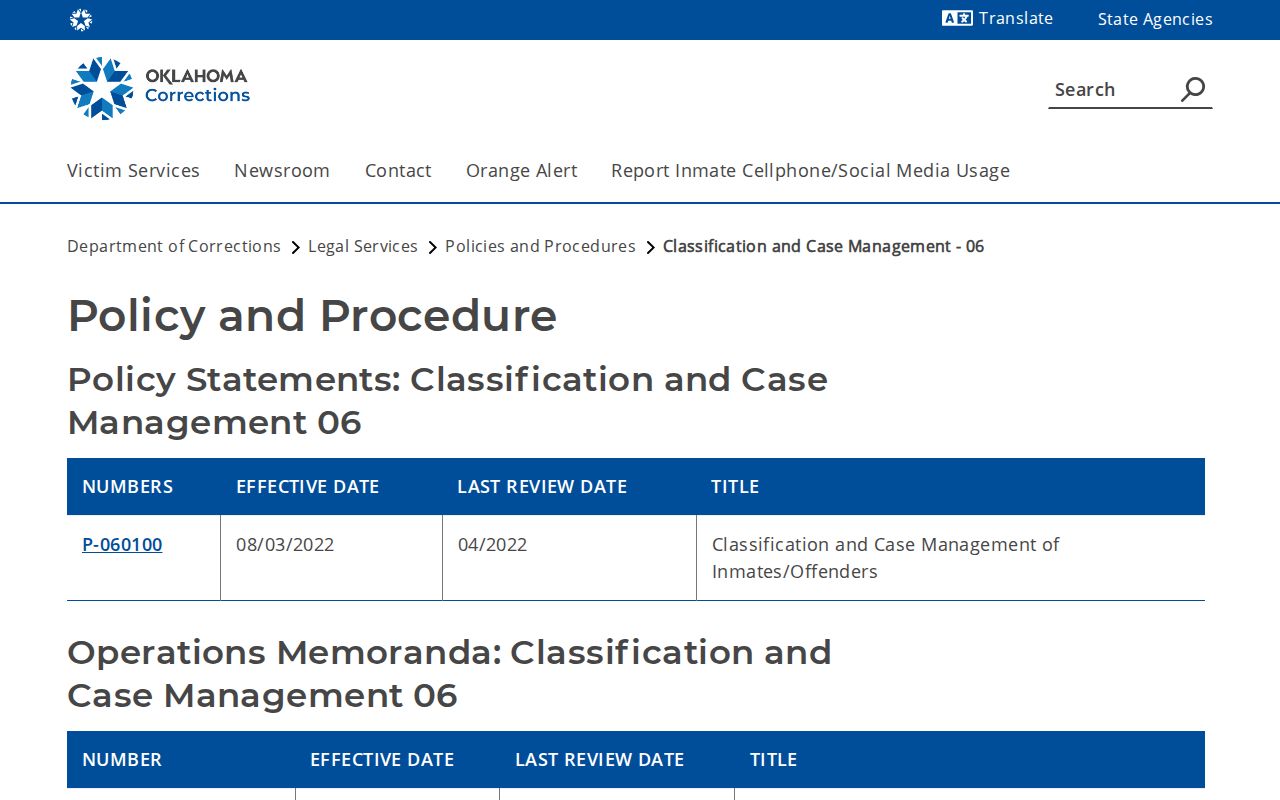
The policy supplies the state calculation route, while the current offender record supplies the person-specific result.
Pontotoc Dates and the 85% Rule
Oklahoma’s 85 percent rule is not universal. Title 21, Section 13.1 sets a service floor for the serious offenses enumerated in that section. For a covered offense, credits cannot authorize release below the statutory minimum. For another offense, Section 138 credits may affect the completion estimate according to the sentence, policy, and any exclusions.
The offense of conviction, offense date, judgment, and current statute version all matter. A charge label on an old county arrest table is not enough. The court’s Judgment and Sentence identifies the controlling result, and ODOC performs the correctional computation. The enumerated list can change, which is another reason not to reuse a fixed chart.
Parole eligibility is also a different date. It marks when a case may be considered under parole law, not the day a sentence must discharge. Oklahoma parole materials describe different eligibility frameworks tied to offense type and date, and some serious offenses have an 85 percent constraint. A Board hearing, favorable vote, and physical prison release can occur at separate times.
Why Pontotoc Release Dates Change
A date can move when a fact or legal input changes. Some changes affect the sentence calculation. Others affect only whether the person can leave a specific facility. Preserve the agency’s label for each event so that a parole date, court order, transfer, and discharge do not collapse into one misleading date.
| Change | Effect on the date or release | Best source |
|---|---|---|
| Earned-credit gain | May advance a calculation when the sentence and rules allow it | ODOC sentence record |
| Credit loss or restoration | May move the projected completion later or earlier | ODOC disciplinary and sentence records |
| Concurrent or consecutive correction | Changes how multiple terms combine | Judgment plus ODOC computation |
| Court modification | Alters the legal sentence or credited time | Pontotoc Court Clerk record |
| Detainer or hold | May prevent community departure even when one booking closes | Current custodian and receiving agency |
| Parole or commutation action | Creates a new decision stage, subject to required approvals and processing | Board result, Governor where applicable, then ODOC |
| Audit or data correction | Revises an administrative field after the record is reviewed | ODOC Sentence Administration |
A detainer is a request or authority from another agency to keep or receive the person. It can make a projected date look complete while custody continues elsewhere. Likewise, a Pontotoc release timestamp followed by delivery to ODOC establishes the end of the county booking, not freedom from custody.
Note: A court authorization, parole action, and jail-door departure may all carry valid but different dates.
Pontotoc County-Sentence Release Dates
A person serving a short term at the Pontotoc County Justice Center does not use an ODOC projected-date field unless the case results in a state commitment. The county path begins with the judgment, credited time, bond status, and any other holds. The sheriff controls the physical release record.
OSCN may show a sentence, dismissal, bond order, modification, or time-served result. Yet the online docket does not usually record when the person crossed the jail door. Ask the Pontotoc County Sheriff for the booking identifier, actual release date and time, release or disposition code, and destination. If another custodian received the person, continue with that agency.
No official local weekend-release statute, good-time schedule, or processing timetable was verified for the Justice Center. That gap should remain explicit. It would be unsafe to estimate a departure hour by subtracting days from the sentence or assuming that a court entry clears every hold.
Pontotoc Release-Date Record Requests
When a public field is missing or unclear, request the existing record from the agency that performs the calculation. For ODOC, use its public Open Records Request form. Include the full name, aliases, date of birth, DOC number, Pontotoc case number, and a useful date range. Ask for the publicly releasable face sheet or master record, actual release or discharge date, public status or type, and institution history sufficient to identify the release event.
A request should distinguish a present projected field from a completed release entry. If the goal is to understand a revised estimate, identify the exact online label and retrieval date, then ask for public records that show the correctional calculation or change. ODOC may withhold protected parts. Its separate closed-records form does not turn confidential material into a public record.
For the Pontotoc County Justice Center, send a narrower request to the Sheriff’s Office. Provide the booked name, date of birth, approximate booking date, case number, and arresting agency. Ask for the booking sheet or jail-register entry, actual release date and time, release or disposition code, bond entry, and destination or receiving agency. The destination resolves whether the event was community release or transfer.
Oklahoma law calls for prompt, reasonable access, but no fixed sheriff or ODOC response time was verified. No local fee table was found either. Request electronic copies and an itemized estimate before costs are incurred. The agency need not create a new calculation or custom report that it does not keep.
Note: Request the existing labeled date and its source record, not a new estimate prepared for the inquiry.
Confirm a Pontotoc Release Date
For a state prisoner, save the exact ODOC field label, retrieval date, DOC number, and displayed status. If the date matters for an official process, request the publicly releasable face sheet or master record, actual release or discharge date, public status or type, and relevant institution history. Ask for an itemized cost estimate because no fixed fee or response time was verified.
For a county inmate, obtain the sheriff’s release record and pair it with the court document. For a pending custody change, the Pontotoc County VINELink check can provide an alert if the responsible agency appears in the live Oklahoma selector. VINE notice is helpful, but the originating agency remains the record source.
If no current result appears, recheck the spelling, birth date, case number, and custodian. Lawful sealing, data lag, transfer, and a search in the wrong system can each cause a blank result. Report only what the source establishes. A projected date remains an estimate until the responsible jail or correctional agency records the completed release.